Best Media Buying Strategies for Consumer Brands in 2026
Media buying in 2026 is all about smarter spending, better targeting, and leveraging new technologies to drive results. Here’s what you need to know:
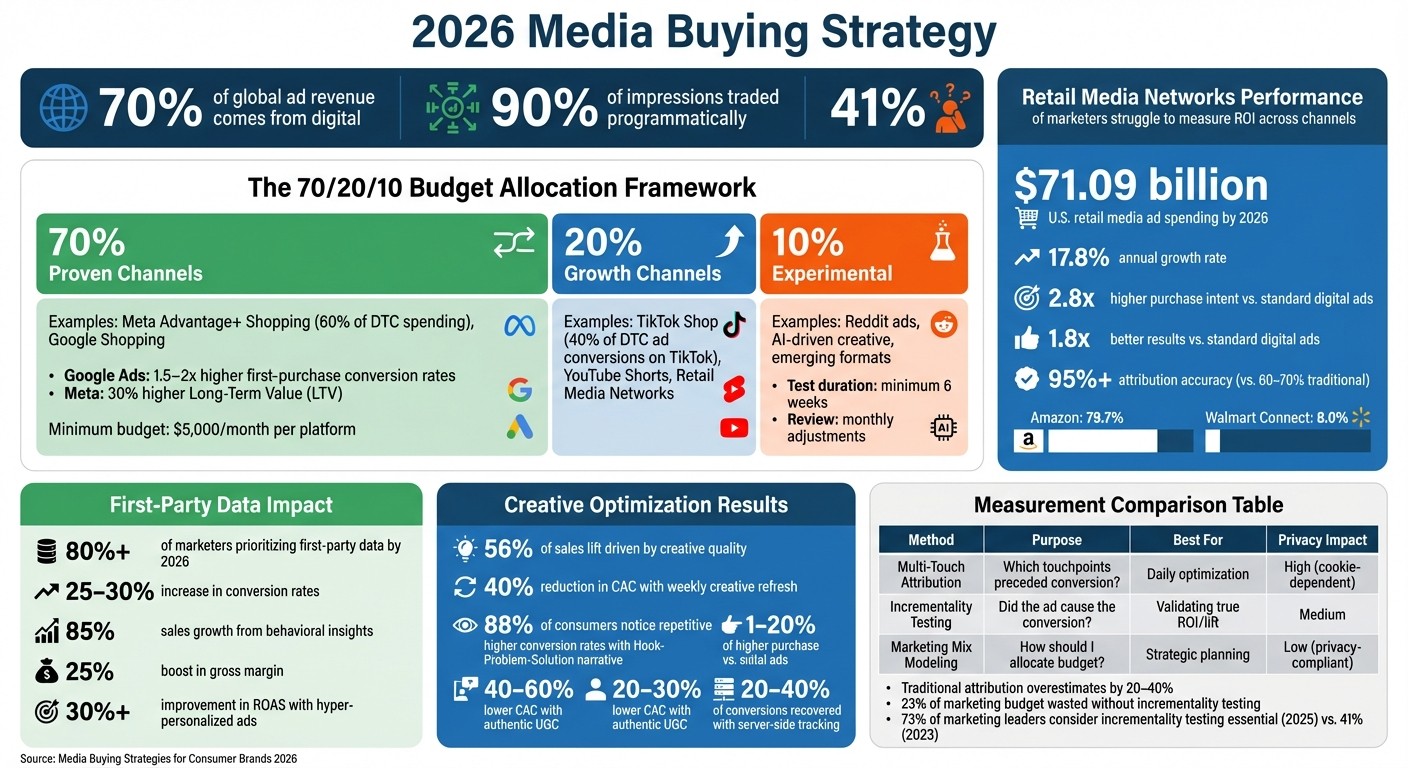
Digital advertising dominates: Over 70% of global ad revenue comes from digital, with programmatic automation trading 90% of impressions.
Key trends shaping strategies:
Challenges: 41% of marketers struggle to measure ROI across multiple channels, pushing for strategies tied to revenue and profit, not vanity metrics.
Top strategies to succeed:
Follow the 70/20/10 budget rule:
70% for proven platforms (e.g., Google, Meta Shopping).
20% for growing channels (e.g., TikTok Shop, YouTube Shorts).
10% for experimental ideas.
Leverage programmatic advertising: Use AI-powered DSPs for precise, multi-channel campaigns.
Prioritize Retail Media Networks: Tap into first-party purchase data for better attribution and higher conversion rates.
Use first-party data for segmentation: Boost conversion rates by 25–30% with precise targeting.
Validate campaigns with incrementality testing and MMM: Avoid wasted spend by measuring true impact.
In 2026, success in media buying means combining data-driven tools, platform-specific creative, and precise measurement to maximize ROI.
2026 Media Buying Budget Framework and Channel Performance Comparison
Media Buying in 2026: Still Think You Know How It Works?
Core Media Buying Strategies for Consumer Brands in 2026
The basics of smart media buying haven’t disappeared - they’ve just evolved. For consumer brands aiming to stretch every dollar while staying competitive, three strategies stand out as essential.
Use the 70/20/10 Budget Allocation Framework
The 70/20/10 framework is a practical way to balance stability with new opportunities. Here’s how it works:
70% for proven channels: Dedicate the majority of your budget to platforms that have consistently delivered results, like Meta Advantage+ Shopping and Google Shopping. For example, Meta's Advantage+ shopping now accounts for 60% of direct-to-consumer spending on the platform.
20% for growth channels: Invest in platforms that show strong potential but aren’t fully mature yet. Think TikTok Shop, YouTube Shorts, or Retail Media Networks. TikTok Shop, for instance, drives 40% of DTC ad conversions on TikTok, making it a powerful way to diversify and reach fresh audiences.
10% for experimentation: Reserve this portion for testing new ideas, like Reddit ads, emerging ad formats, or AI-driven creative strategies. According to the Spendmix Blog:
"The 70/20/10 rule says put 70% of your budget in proven channels, 20% in promising ones, and 10% in experiments."
Run experiments for at least six weeks, with enough budget to gather meaningful data. Quickly cut underperformers and scale up the winners.
This framework isn’t set in stone - review your 70/20/10 allocation quarterly, and adjust the experimental 10% monthly as new data rolls in. Each channel should have a minimum budget - around $5,000 per month for platforms like Google Search - to ensure algorithms can optimize effectively. For example, Google Ads often deliver 1.5–2x higher first-purchase conversion rates compared to Meta, although Meta customers tend to have 30% higher Long-Term Value (LTV).
With a structured budget in place, programmatic advertising can help you scale efficiently.
Use Programmatic Advertising for Scale and Precision
Programmatic advertising has become the standard, with over 90% of digital display impressions in the U.S. now traded programmatically. Demand-Side Platforms (DSPs) handle the heavy lifting, automatically buying impressions across websites, apps, and Connected TV through real-time auctions.
Modern DSPs use AI to optimize bids, shift budgets, and expand audiences in real time - all while staying aligned with your campaign goals, like return on ad spend (ROAS) or cost per acquisition (CPA). You set the economics - your maximum allowable customer acquisition cost - and let the system execute.
Running campaigns across multiple channels pays off. Multi-channel efforts see purchase rates nearly 300% higher than single-channel campaigns. Additionally, 52% of marketers are reallocating budgets from open web DSPs to retail media platforms, which leverage verified purchase data. Megan Conahan, EVP of eCommerce at Direct Agents, explains:
"Retail media DSPs are winning not because they're cheaper, but because they replace proxy signals with verified purchase behavior and attribution marketers can actually defend."
For instance, connecting programmatic CTV campaigns to Amazon or Walmart shopper data allows you to track video ad exposure directly to purchases. This level of precision makes programmatic buying a cornerstone of modern media strategies.
To target high-intent audiences even more effectively, retail media networks are key.
Focus on Retail Media Networks for High-Intent Audiences
Retail Media Networks (RMNs) allow you to reach shoppers right as they’re ready to buy. By 2026, U.S. retail media ad spending is expected to hit $71.09 billion, growing 17.8% annually. RMNs deliver 2.8x higher purchase intent and 1.8x better results compared to standard digital ads.
Platforms like Amazon, Walmart, and Target use first-party data to link ad impressions directly to verified transactions. This approach achieves attribution accuracy of over 95%, compared to the 60–70% range typical of traditional digital advertising.
Amazon leads the pack, holding 79.7% of the market share in 2025, followed by Walmart Connect at 8.0%. RMNs are also expanding into offsite channels like Connected TV and social media. For example, Walmart partnered with Disney in 2024, enabling advertisers to use Walmart audience data for targeting on Disney’s streaming platforms, with sales impact measured through secure data-sharing environments known as clean rooms.
Sarah Moss from AI Digital highlights the shift:
"Retail media now sits where intent is highest - closer to the basket than almost any channel - and it finally links exposure to sales with closed-loop attribution."
Start with Sponsored Products on Amazon or Walmart, as these onsite search ads deliver the highest ROAS and help secure "digital shelf" space. From there, expand into offsite formats like Connected TV or social media, leveraging the same shopper data for targeting. To optimize further, connect your ad platforms to live inventory feeds so spending automatically pauses on out-of-stock items. When working across multiple RMNs, align attribution windows (e.g., 7-day vs. 30-day) to ensure accurate performance comparisons.
Data-Driven Approaches to Improve Media Buying Performance
By 2026, successful media buying will lean heavily on data to refine strategies and measure effectiveness. Brands making the most progress are those leveraging first-party data for precise audience segmentation and employing rigorous testing to confirm campaign results rather than relying on surface-level correlations.
Build Audience Segments with First-Party Data
The backbone of any strong media buying strategy is effective audience segmentation, and first-party data is the key to achieving this. Data from your website, app, CRM, or loyalty programs allows for precise targeting. In fact, by 2026, over 80% of marketers are expected to prioritize first-party data in their paid media strategies, which typically leads to a 25–30% increase in conversion rates.
To make the most of this data, companies must go beyond basic analytics. A structured data architecture is essential. By storing event-level data in cloud platforms like BigQuery or Snowflake, businesses can create a unified data source. From there, audiences can be segmented based on identity, behavior, experience, and operational data. Companies that use customer behavioral insights often see significant advantages, including 85% sales growth and a 25% boost in gross margin.
These segments can then be applied in various ways. For instance, hashed email or phone lists can be synced with platforms like Google, Meta, or TikTok. For real-time targeting, reverse ETL processes can push warehouse data directly into ad platforms. Suppressing existing customers from acquisition campaigns can also help avoid wasting ad spend on those who have already converted. Additionally, hyper-personalized ads built on first-party data can yield a 30%+ improvement in ROAS.
Another way to enhance your data strategy is by using progressive profiling through micro-surveys. This builds trust and gathers actionable insights. As admocker.com puts it:
"Trust is the new currency in data-driven marketing. Transparent, opt-in relationships outperform forced data grabs every time." - Expert Insight, admocker.com
Once you’ve nailed down your audience segmentation, the next step is validating the actual impact of your campaigns.
Use Incrementality Testing and Multi-Touch Attribution
After segmenting your audience, measuring the true impact of your campaigns is critical. Multi-Touch Attribution (MTA) helps identify the touchpoints that lead to conversions, which is great for daily optimization. However, MTA alone doesn’t confirm whether your ads directly caused a sale.
Traditional attribution models often overestimate the contribution of specific channels by 20–40%. For instance, when platforms like Google, Meta, and email all claim credit for the same sale, it can lead to inflated conversion numbers. Without incrementality testing, brands risk wasting 23% of their marketing budget on activities that don’t actually drive results. By 2025, 73% of marketing leaders considered incrementality testing a must-have, compared to just 41% in 2023.
Incrementality testing works by holding out 10–15% of your audience and comparing their conversion rates to those exposed to your ads. For businesses with limited user-level data, Geo-lift testing is a solid alternative. This involves running ads in one region while suppressing them in a similar region, then measuring the difference. These tests typically run for 4–8 weeks to capture the full conversion cycle.
To get a complete picture of performance, combine MTA with Marketing Mix Modeling (MMM). Unlike MTA, MMM uses aggregate data for strategic budget allocation and doesn’t rely on individual user tracking. This "three-legged stool" approach - MTA for tactical insights, MMM for planning, and incrementality testing for validation - is the go-to method for 2026. Tools like Meta’s Meridian and Google’s LightweightMMM are making MMM more accessible, while server-side tracking can recover 20–40% of conversions lost due to browser limitations or ad blockers.
Measurement Type | What It Answers | Best For | Privacy Impact |
|---|---|---|---|
Multi-Touch Attribution | Which touchpoints preceded conversion? | Daily optimization | High (cookie-dependent) |
Incrementality Testing | Did the ad cause the conversion? | Validating true ROI/lift | Medium |
Marketing Mix Modeling | How should I allocate my budget? | Strategic planning | Low (privacy-compliant) |
Creative and Channel Optimization for Maximum ROI
Once you've confirmed your campaign's effectiveness through incrementality testing, the next step is fine-tuning how your ads look and where they appear. By 2026, creative quality is expected to drive up to 56% of sales lift in digital campaigns. The visuals, messaging, and formats you use are crucial - they guide algorithms to match your ads with the most relevant audiences.
Personalize Creative Assets Across Channels
Today, the creative content of your ads does more than just deliver a message - it acts as the targeting tool. Algorithms analyze your ad's visuals and copy to decide which audiences to show it to. Jemma from Krev.ai puts it plainly:
"When I say creative is the new targeting, I mean this literally. The visuals and copy in your ads are what Meta uses to find the right people."
This means your ads must align with the unique browsing habits of each platform. For instance, Meta users are often in a "scroll-to-buy" mindset, looking for polished, benefit-centric messaging. On the other hand, TikTok users lean toward entertainment, favoring raw, casual content that feels relatable.
To stay ahead, adopt a "Creative Velocity" strategy by testing 20–50 creative variations each week. This isn't about small tweaks like button color changes - it's about experimenting with entirely different concepts. For example, you might compare founder stories with customer testimonials or test problem-solution narratives against before-and-after transformations. Brands that refresh their creative weekly can reduce customer acquisition costs by 40%. Meanwhile, 88% of consumers notice repetitive ads, which can negatively impact brand perception.
One way to maintain this creative momentum is through modular production. By creating five different hooks, three body segments, and three calls-to-action, you can remix these elements into 45 unique ad variations (5 × 3 × 3 = 45).
The first 1–3 seconds of your ad - your "Hook Rate" - are critical. If you can't grab attention immediately, the rest of your ad won't matter. Hooks that perform well in 2026 often use "Drama Set-ups" that jump straight into the action. Pair this with bold, high-contrast captions (85% of Facebook video is watched on mute) and visual effects that highlight product details.
Platform | User Mindset | Creative Approach | Audio Strategy | CTA Style |
|---|---|---|---|---|
Meta (FB/IG) | Scroll-to-buy / Discovery | Polished, high-quality UGC; benefit-first | Optional (often watched on mute) | Direct ("Shop Now") |
TikTok | Entertainment / Dopamine | Raw, lo-fi, trend-driven | Mandatory (sound-on) | Soft ("Link in bio") |
This tailored creative approach lays the groundwork for optimizing mobile and interactive ad formats.
Design Mobile-First and Interactive Ad Formats
Building on the idea of personalized creative, mobile-first and interactive ad designs can further boost engagement and ROI. With the majority of Meta traffic coming from mobile devices, designing for mobile is no longer optional. The format of your ad directly influences both engagement and cost efficiency. For example, short-form videos under 15 seconds in a 9:16 aspect ratio perform well on Reels and TikTok, while static image ads featuring elements like comparison charts, before-and-after visuals, or social proof are regaining popularity during the consideration phase.
To ensure your message isn't obscured by platform interface elements (like "Shop Now" buttons or music tickers), design within "Safe Zones." Keep critical text and visuals inside the central 1080×1350 pixel area of a 9:16 video.
Interactive elements like stickers, polls, or notification bubbles can make ads feel more organic and less intrusive. Formats like Collection Ads allow users to browse product catalogs without leaving the app, creating an immersive shopping experience. Meanwhile, Carousel Ads are ideal for storytelling or showcasing multiple products during the consideration phase.
When paired with proven media buying strategies, optimized creative assets and mobile-first designs can maximize ROI in 2026. Ads that follow a "Hook-Problem-Solution" narrative arc can achieve 40–60% higher conversion rates compared to those focused solely on features. Additionally, incorporating user-generated content can lower customer acquisition costs by 20–30%. However, for this approach to work, the content must feel authentic and unpolished - overly scripted UGC risks triggering users' mental ad blockers.
How Bigeye Supports Consumer Brand Media Buying
To take full advantage of modern, creative, and data-driven strategies, brands need a well-integrated tech solution. Implementing 2026 media buying strategies successfully requires tools that seamlessly unify channels and data streams. Bigeye provides this through its combination of automation and strategic support.
EyeQ and EyeSight: Unified Performance Tracking
One of the most pressing challenges for consumer brands in 2026 is dealing with fragmented data. Campaign metrics from sources like paid search, social media, programmatic ads, and retail media are often scattered across multiple dashboards. Bigeye addresses this issue with its proprietary platforms, EyeQ and EyeSight, which consolidate fragmented data into unified, actionable insights. These tools integrate seamlessly with the data-driven strategies needed for modern media buying.
EyeQ and EyeSight provide real-time insights that focus on sales and ROI, allowing brands to pinpoint which creative elements are driving conversions across channels. This empowers teams to make quick adjustments to their media strategies, ensuring campaigns remain effective and responsive to consumer behavior.
Bigeye also offers flexible pricing models, making these tools accessible to brands of all sizes.
Bigeye's Pricing and Plans
Bigeye has developed three engagement models designed to meet the needs of brands at different stages of growth. Moving away from rigid annual contracts, these plans reflect the evolving 2026 trend toward flexible strategies that adapt to rapid shifts in technology and consumer preferences.
Plan Name | Best For | Core Focus | Key Benefits |
|---|---|---|---|
Strategic Foundation | Emerging or repositioning brands | Consumer insights, brand positioning, creative direction | Builds a research-driven strategy before launching media campaigns |
Monthly Support | Brands scaling campaigns | Creative production, performance tracking, optimization | Provides clear monthly deliverables with ongoing testing and refinement |
Custom Engagement | Brands with advanced requirements | Tailored mix of research, creative, media buying, analytics | Includes full access to EyeQ and EyeSight platforms with a custom-defined scope |
The Strategic Foundation plan is perfect for brands just starting out or those looking to refine their positioning. It focuses on the groundwork - like consumer research, audience segmentation, and creative direction - before diving into campaign execution.
Once a solid strategy is in place, the Monthly Support plan offers ongoing campaign management with a focus on continuous optimization. This approach ensures that activities are directly tied to measurable business outcomes, keeping planning cycles short and results-driven.
For brands with more complex needs, the Custom Engagement plan provides a fully tailored solution. This includes full access to Bigeye's proprietary platforms, EyeQ and EyeSight, and allows for a custom-defined scope based on specific requirements. All three plans integrate first-party data from sources like CRM systems, site analytics, and app data to create high-intent audience segments. Additionally, they utilize advanced analytics tools, such as multi-touch attribution (MTA) and Marketing Mix Modeling (MMM), to measure true incremental impact rather than relying on correlation alone.
Conclusion
The shift from focusing on sheer volume to prioritizing value in media buying isn't just a trend for consumer brands - it's become a necessity to remain competitive in 2026. Sticking to outdated, rigid budgeting methods is like navigating without a map in an increasingly complex landscape.
The approaches discussed - like the 70/20/10 framework, leveraging first-party data, and tailoring creative content - highlight a critical takeaway: effectiveness trumps efficiency. At the end of the day, profit and loss statements care about real incremental gains, not flashy metrics like cheap clicks or high impression counts.
With consumer behaviors changing fast, algorithms constantly evolving, and attribution models sometimes misrepresenting ROAS by over 20%, flexibility is key. Brands must embrace tools like real-time budget adjustments, cross-channel frequency controls, and advanced measurement systems that go beyond last-click attribution to uncover true incremental value.
This transformation demands more than strategy - it requires the right tools to bring those strategies to life. Whether you're fine-tuning budget plans or improving cross-channel performance, these insights can guide you toward decisions that drive revenue in real time. Winning in 2026 will mean blending data-driven strategies with creative brilliance - and having the systems in place to act on insights the moment they emerge.
FAQs
How do I pick my 70/20/10 channels for my brand?
To determine your 70/20/10 channel allocation, start by setting minimum spend thresholds for each platform - for example, $5,000 per month for Google Search or $3,000 per month for Meta. Dedicate 70% of your budget to channels that consistently deliver strong marginal ROAS (Return on Ad Spend) for your core strategy. Allocate 20% to platforms that show potential for growth, and keep 10% for testing experimental formats. This approach creates a dynamic, data-informed media mix that aligns with your goals while adapting to market shifts.
What’s the fastest way to start using first-party data in ads?
The fastest way to put first-party data to work in your ads is by gathering it from sources you already control, like your website or CRM. Use tracking tools to monitor customer interactions, and then organize the data into segments based on behaviors or where customers are in their journey. Feed these insights directly into ad platforms to fine-tune your targeting and boost ad performance - all without requiring a complex setup.
How can I prove ads created sales (not just got credit)?
To demonstrate that ads drive sales rather than merely taking credit, leverage data-driven attribution models. These models help analyze customer journeys across various channels, pinpointing how ads influence conversions. Pair this approach with advanced analytics and merge both offline and online data for more precise attribution.
Another option is to run controlled experiments, such as A/B testing or geo-based testing. These methods measure incremental sales by isolating the actual effect of ads on purchasing behavior, giving a clearer picture of their impact.

Branding & Creative
Apr 19, 2026
A practical framework to audit merged brand portfolios, assign power and sub‑brand roles, choose the right model, and execute a post‑M&A rollout.