
Producing high-volume ad campaigns requires efficient systems to manage creative workflows, reduce bottlenecks, and maintain performance across platforms. With ad platforms automating targeting, the quality and frequency of your assets now directly impact results like ROAS and user acquisition.
Key takeaways for improving production:
Audit your workflow: Break down processes into stages (intake, scoping, execution, approval, delivery) to identify delays and inefficiencies.
Address bottlenecks: Approval delays and unclear requests waste time - aim for faster approvals (within 48 hours) and better scoping upfront.
Maximize team capacity: Only 28% of creative teams' time goes to actual production. Use automation to cut repetitive tasks and focus on impactful work.
Leverage modular systems: Create reusable components (hooks, visuals, CTAs) to generate multiple variations from a single asset.
Automate and test: Use AI tools to generate platform-specific variations, automate testing, and scale high-performing creatives.
Tailor for platforms: Customize formats, aspect ratios, and styles for Meta, TikTok, YouTube, and Google Display to reduce acquisition costs.
Review Your Current Creative Workflow
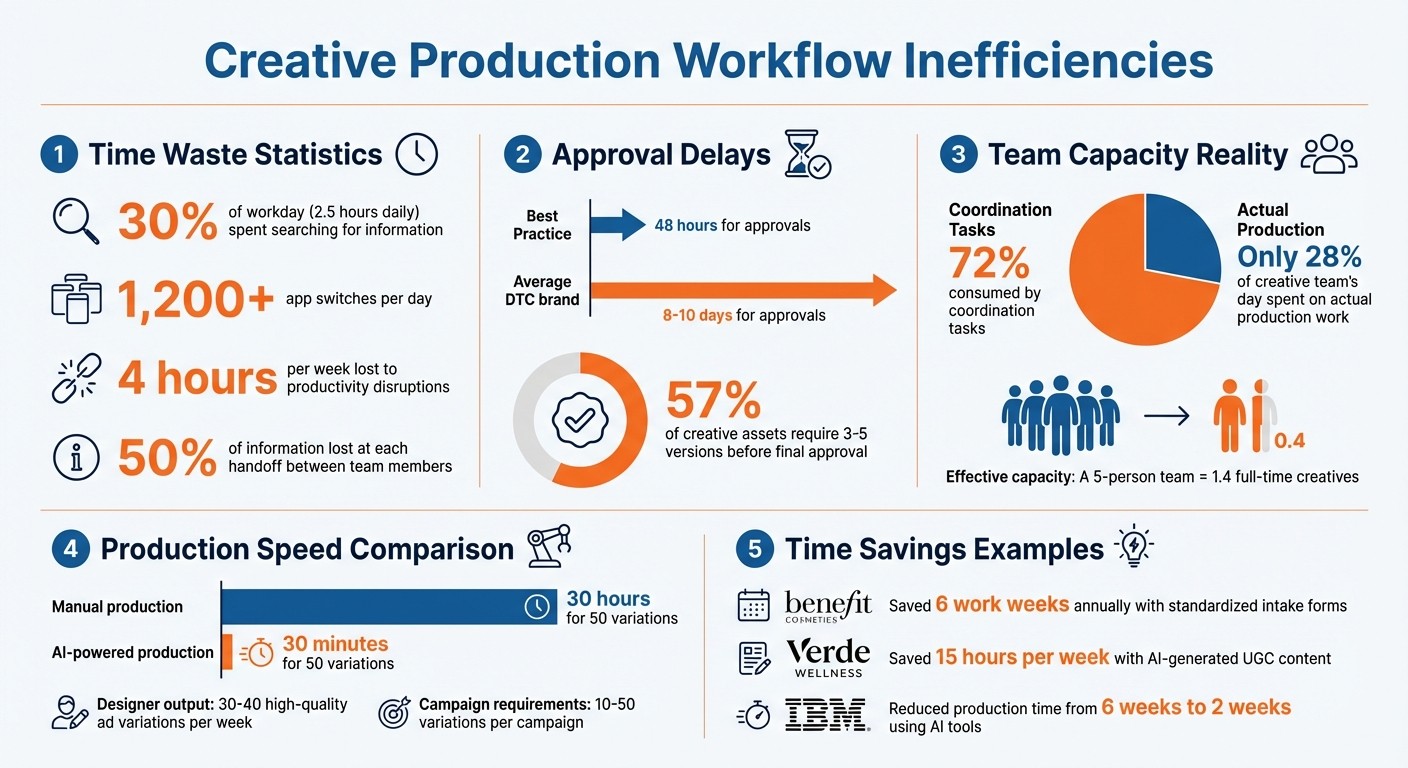
If you want to keep up with the demands of producing high-volume ads and running successful campaigns, you need to take a hard look at your creative workflow. Before you can scale, you have to figure out where things are breaking down. Often, the way you think your process works doesn’t match up with reality. Break your workflow into five stages - intake, scoping, execution, approval, and delivery - to reveal inefficiencies hiding under the surface [7]. Document every team involved at each step and compare their reported workflows to what’s actually happening [8].
Chances are, you’ll find some major gaps. Consider this: knowledge workers spend 2.5 hours every day - 30% of their workday - just searching for the information they need [6]. They also switch between apps over 1,200 times daily, losing about four hours of productivity each week [6]. Laura Antos, Senior Manager of 360 Marketing Operations at Northstar New Jersey Lottery Group, shared her experience with these challenges:
"Requests or comments would occasionally be lost or misfiled, and we would also catch errors too late, which required reprinting... I realized very quickly that managing projects this way wouldn't scale" [8].
Once you’ve mapped out your workflow, dig into each stage to uncover bottlenecks that are slowing you down.
Find Production Bottlenecks
Bottlenecks like unclear requests and approval delays are common culprits [7]. For example, the best teams aim to wrap up approvals within 48 hours, but the average DTC brand takes 8-10 days to approve creative work [6]. On top of that, 50% of information gets lost at each handoff between team members, tools, or stages [6].
To get to the root of these problems, try using the "5 Whys" technique [9]. Here’s an example: Why was the ad late? Because approval took too long. Why? Stakeholders weren’t available. Why? They weren’t notified in time. Why? There’s no automated handoff system. Why? The team uses disconnected tools. That’s how you pinpoint the real issue.
It’s also critical to measure how long each stage actually takes instead of relying on estimates. For instance, in January 2026, Benefit Cosmetics’ US creative team was juggling 75 projects at once, plus 50-60 new work requests each month. By using standardized Asana intake forms to gather all necessary details upfront - like scope, audience, stakeholders, and deadlines - they eliminated constant back-and-forth communication and saved nearly six work weeks annually [1].
Once you’ve identified these bottlenecks, it’s time to evaluate whether your team’s resources are contributing to the delays.
Measure Team Resources and Capacity
Understanding your team’s capacity isn’t just about counting heads. On average, only 28% of a creative team’s day is spent on actual production work. The other 72% gets eaten up by coordination tasks [6]. That means a five-person team is effectively working as if it’s only 1.4 full-time creatives [6].
To get a clear picture of your team’s capacity, focus on three areas:
Work versus capacity: Compare your team’s actual output to what you expected they could handle.
Capacity utilization: Track how much time is spent on productive work versus administrative tasks.
Skill deployment effectiveness: Check if senior talent is being used for strategic work or bogged down with routine tasks [5][10].
You should also monitor your cycle time (how long it takes from request to delivery) and your on-time delivery rate [2][5]. If 57% of your creative assets need 3-5 versions before final approval, you’re wasting valuable time on rework that could’ve been avoided with better scoping upfront [6].
Michael LaBerge, Director of Strategic Operations at Copper Giants (Liberty Mutual’s in-house agency), highlighted the importance of tracking operational data:
"Operational data has helped us grow as a team... It helped us quantify resourcing needs when requests were on the rise. It prepared us for the ebbs and flows of work throughout the year" [8].
Don’t waste time trying to fix every single exception. Focus on simplifying the 80% of your process that can be standardized. Even if one executive insists on avoiding digital approvals, streamline the rest [7]. Once you have these baseline metrics, you’ll know exactly where automation and additional resources can make the biggest impact. That’s how you scale your creative output effectively.
Build a Scalable Creative System
Once you've identified bottlenecks and assessed your team's capacity, the next step is to create a production system designed to handle high volumes without sacrificing quality. The secret? Treat creative work as a system of flexible building blocks instead of standalone, finished pieces [11]. This modular method allows a single hero asset to transform into dozens of variations tailored for different channels, audiences, and formats - saving both time and money [11]. It’s a smart way to meet the demands of high-volume creative production while keeping workflows efficient.
Create Modular Assets
Modular assets are the backbone of scalable creative systems. Think of each ad as a collection of reusable components: base assets (like a hero video or image), hooks and openings (attention-grabbing intros), visual elements (such as interchangeable backgrounds or product shots), and copy modules (customized headlines and CTAs for different audiences) [11]. This setup enables true scalability, allowing you to mix and match elements rather than starting from scratch every time.
Here’s a reality check: a single designer typically produces 30-40 high-quality ad variations in a week, but today’s performance marketing often requires 10-50 variations per campaign, across multiple campaigns running simultaneously [12]. Leveraging AI tools can drastically speed up modular production, cutting the time needed to create 50 variations from 30 hours to just 30 minutes [12]. To make this work, plan for modularity from the start. Design scripts and shoots with reusable elements in mind [11]. Also, establish a shared taxonomy with consistent tagging and metadata so your modular assets are easy to find and reuse across global teams [11][5].
Set Clear Workflow Timelines
Vague timelines can derail high-volume production. To avoid this, set strict deadlines for every stage of the process: concept development, creation, review, and deployment. For instance, reviews might follow these guidelines: 24 hours for social posts, 48 hours for campaign assets, and 72 hours for external communications. If approvals are delayed, have escalation protocols in place to keep things moving [2]. Automated handoffs can also help by instantly notifying the next team member when a task is completed, reducing downtime between stages [1][5]. On high-volume platforms like Meta or TikTok, stick to a consistent creative refresh schedule - aim for 5-7 new pieces weekly or biweekly to avoid creative fatigue [3].
Speed Up Production with Automation
Once you've established a modular system with clear timelines, automation becomes the driving force behind high-volume production. Creative teams often spend just 30-40% of their time on actual creative tasks, with the rest consumed by repetitive work like file management and resizing [4]. By leveraging AI automation, production time can be reduced by 40-60%, allowing your team to focus on strategic thinking and innovation rather than time-consuming, mechanical tasks [4]. This naturally extends to scaling asset creation using AI tools.
AI-Powered Asset Generation
AI tools are remarkably effective at transforming a single master asset into multiple platform-specific variations without the need for manual input. To make the most of this, break your creative into modular components: hooks (the first few seconds), bodies (your value proposition), and CTAs (the call to action). With just 5 hooks, 5 bodies, and 4 CTAs, you can generate 100 unique creative variants in a matter of minutes [14].
Here's a real-world example: IBM used Adobe Firefly to produce over 200 original images and 1,000 character variations, cutting production time from six weeks to two while increasing engagement by 26x [14]. Similarly, Hatch, a sleep wellness brand, created 60 ad variations using just three personas and three videos. This approach led to a 50% reduction in production time, a 97% drop in costs, and an 80% increase in click-through rates [14].
Modern AI systems also streamline asset management by automatically categorizing content for quick access. Instead of manually sorting through raw footage, AI can analyze and tag clips as "hooks", "testimonials", or "product demos", making them instantly searchable when building new variants [15]. This eliminates hours of file management and ensures your team can quickly locate the right components.
Automated Testing and Optimization
Predictive scoring algorithms take automation a step further by estimating creative performance before you invest in media. These algorithms filter AI-generated variants, allowing you to launch only the top-performing options. Some platforms report up to 90% accuracy in predicting outcomes based on historical data from hundreds of thousands of assets [14].
Once your modular system is in place, automated testing ensures that only the best-performing variants are scaled. For example, automated systems can handle A/B testing at scale, tweaking one variable at a time. You could test 10 different hooks with the same body and CTA to identify the most effective combination [14]. By setting clear "kill criteria" - such as pausing any variant that doubles your target cost per acquisition after 500 impressions - you can let automation handle the heavy lifting [14]. This is especially critical on platforms like TikTok, where ad creatives often burn out after just seven days [14]. Automation keeps your campaigns fresh, retiring underperformers and continuously introducing new variants based on real-time data.
The benefits of these workflow improvements add up over time. For instance, Discovery Digital Studios uses automated handoffs between departments to produce thousands of videos each month, managing up to six platform-specific versions of every video simultaneously [1]. Similarly, Benefit Cosmetics' US creative team streamlined their process with standardized automated request forms, handling 50-60 work requests per month and saving nearly six work weeks of labor annually [1].
Adapt Creative Assets for Each Platform
Once you’ve built a scalable creative system, the next step is tailoring your assets for each platform. A generic, one-size-fits-all approach simply doesn’t work anymore. Creative has become the main tool for targeting, with algorithms analyzing your ad content to decide who sees it. This makes platform-specific customization a key way to lower customer acquisition costs in 2026 [21]. People expect ads to feel like they belong on the platform they’re using. For example, overproduced ads on TikTok or professional-looking content on Reddit tend to blend into the background and get ignored [20][21].
Even technical details, like aspect ratios, can make or break engagement. For instance, vertical videos on Facebook deliver a brand lift 70% of the time compared to square formats, with ad recall increasing by 3-9 points [18]. To efficiently cover about 90% of social media audiences, create three core versions of each asset: Vertical (9:16), Square (1:1), and Landscape (16:9) [18]. This way, you can optimize your content for different platforms without starting over every time.
Social Media Platforms (Meta, TikTok)
TikTok and Meta demand completely different creative approaches. TikTok thrives on casual, creator-style content, while Instagram Feed users prefer polished, visually appealing imagery [16][17]. On both platforms, the first 3 seconds are critical - 65% of viewers who stick around for those initial moments will continue watching for at least 10 seconds [17]. So, your hook needs to grab attention instantly.
Sound usage also varies by platform. On Meta, 85% of videos are watched without sound, so captions and strong visuals are essential [17]. Meanwhile, TikTok is a "sound-on" platform where trending audio can significantly boost distribution [16]. For Meta, focus on silent storytelling with bold on-screen text. For TikTok, lean into voiceovers and popular audio tracks.
For formats, use 9:16 for TikTok, Reels, and Shorts, while Meta Feeds work best with 1:1 or 4:5 [16][17][18]. Keep TikTok videos between 9-15 seconds and Meta videos between 6-15 seconds [16][17]. User-generated content (UGC) is especially effective, delivering 4x higher click-through rates and cutting acquisition costs by 50% compared to polished branded content [17]. In early 2026, Verde Wellness tackled a drop in engagement (from 4.2% to 1.8%) by using an AI-based system to generate three UGC-style videos daily. This brought engagement back to 4.2% while saving 15 hours of production time each week [21].
Adapting your assets for video and display channels requires a similarly thoughtful approach.
Video and Display Advertising
Platforms like YouTube and Google Display call for unique strategies based on their formats. On YouTube, make sure your brand logo or key message appears within the first 5 seconds - right before the "Skip Ad" button pops up [20]. YouTube Shorts perform best when they’re under 60 seconds in a 9:16 vertical format, while traditional pre-roll ads work better in a 16:9 landscape layout [20].
For Google Display ads, think of them as digital billboards. Keep the copy short and visuals bold [20]. The most effective ad sizes are:
300×250 (Medium Rectangle)
728×90 (Leaderboard)
160×600 (Wide Skyscraper)
Ensure files are under 150KB and use action-driven CTAs like "Shop Now" [20]. Also, leave 15% of the top and bottom clear of text or logos to avoid overlap with platform UI elements, like profile icons or captions [19].
When exporting videos, stick to these specs: H.264 codec, 30 FPS, and VBR 2-pass encoding [19]. For audio, use AAC format, a 48 kHz sample rate, and a bitrate of at least 192 kbps [19]. Following these standards ensures your content looks and sounds great across all platforms.
Conclusion
Streamlining high-volume creative production starts with analyzing workflows to pinpoint inefficiencies, adopting modular systems for scalability, leveraging automation to speed up processes, and tailoring content for each platform. By mapping out your entire production process, you can uncover hidden delays and eliminate unnecessary steps.
Automation pays off fastest here. With AI-powered tools, teams can save up to 40% of their time by automating repetitive tasks like intake requests and approval notifications [5]. This saved time can then be redirected to more meaningful, creative work rather than administrative tasks [1].
These time savings pave the way for platform-specific strategies. Customizing content for each platform is crucial for reducing acquisition costs and maintaining performance. As Angad Singh highlights, quickly producing 10 data-driven iterations is essential to staying competitive [3]. On high-volume platforms like Meta and TikTok, aim to refresh 5 to 7 creatives every one to two weeks to avoid creative fatigue [3].
If your team is shipping more variants than ever and still can't tell which ideas deserve the production budget, talk to Bigeye. Our EyeQ research puts concepts in front of real consumers and returns results in about 72 hours, so you can build the modules that are already proven to land.
FAQs
What’s the fastest way to find bottlenecks in our creative workflow?
To spot bottlenecks in your creative workflow, take a closer look at each step of your process. Pay attention to areas like briefing, review, approval, or delivery where delays often occur. Tools like Asana or Monday.com can help you map out progress and identify where things are getting stuck. Make it a habit to collect feedback from your team and monitor timelines regularly. This will help you identify recurring problems and make changes that keep everything running more smoothly.
How do we build modular ad assets without hurting brand consistency?
To produce modular ad assets efficiently while staying true to your brand, start by creating a system of reusable components. These might include headlines, images, and calls-to-action (CTAs) that are pre-approved and align with your brand guidelines.
Organize these components in a digital asset management (DAM) system. This ensures everything is easy to find, properly categorized, and under version control. By doing so, you can scale your ad production for high-volume campaigns while ensuring your brand identity and quality remain intact.
Which AI tasks should we automate first to scale creative output safely?
To boost creative output while maintaining safety and quality, start by automating tasks that improve efficiency and simplify production. Prioritize areas like creating multiple ad variations, refining creative assets, and organizing feedback workflows. These steps help cut down on manual delays, maintain consistent standards, and speed up iterations - key factors for managing high-volume campaigns. Using AI for these processes allows for scalable, data-informed creative production without sacrificing results.
Related from Bigeye
Case study: Coursera
Podcast: Creative Production for Marketers with Jillian Gibbs

Paid Media & Performance
Oct 7, 2026
A retail media strategy for 2027 in eight steps, with Bigeye shopper research and current data on Amazon, Walmart, Instacart and measurement.